|
| Don B Snyder |
This is Part 7 of a 13-part blog series sharing my Grand-uncle Don’s life story, in his own words, via an autobiography sent to me by Don’s grandson, Ron Oldfield, after Ron stumbled across one of my prior posts about his grandfather. It is shared with the permission of both of Don’s children and Ron Oldfield. [Note – Anything in brackets with green type is my added explanation of something in Don’s text. ]
Don’s story:
Part 7 – The Japs
 |
38th infantry division Avengers of Bataan
Image bought from Veteran Graphics
|
The trip to the Philippines was uneventful except a Jap plane dropped a bomb that missed us. [Don was a technical sergeant for the 151st Infantry, 38th Division.] While in a convoy we almost came close to a floating mine. We were told no lights or cigarettes after dark as the subs could see it a mile away. On our right was a big landing craft with lights all over it. We landed at Tacloban, Leyte. Tents were put up at the beach to hold supplies for when the regiment left for Luzon. I was in charge and a pretty 16-year-old girl was doing my laundry. She always had some younger girls with her. They were always giggling and they would tell me “Bolita” loved me. I asked her and she would say “no!” Later I found out that meant yes at first. One day she asked me to go to her village with her. I said no, then I thought “why not?” She was pretty with a nice shape. These people were the evacuees from the Japs. To get there we had to wade up a couple creeks and a couple of trails. When we got there the men folks were real nice to me. I found out they recognized me as they, 200 men, worked for me putting up the tents. She then said why not spend the night there. I had to think about it and asked her if she would sleep there in a hut with me, she said yes. I asked, “will we be alone?” She said no. I said, “who else?” She said nine others. These men had big bolo knives and I got to thinking, said goodbye and went back. Had quite a time in the creeks but made it. On getting back I found orders had changed and we moved 30 miles north. There I got another surprise. Being the only weapons platoon sergeant in the battalion headquarters I was picked to lead a four-day patrol. Go in a square for hunting Japs. I felt it was quite an honor. I picked out 10 men, loaded up with rations etc., and started out. They said the Japs were starving and weak. Yeah, I thought, how much strength does it take to pull a trigger, and I would be the front man. The training was that the leader was back aways to control things and he would send out a couple of scouts in front. I never recognized that idea and would be in front. Hadn’t went 30 feet when a Jeep drove up honking its horn. Said to come back as we were all moving out. I was kind of glad (yeah) to hear that but I really did want to do it.
On to the Philippines. We made a landing at San Felipe on Luzon, just north of Subic Bay. Fought a bad one at Zig Zag Pass. We relieved, I think, the 42nd Division. It was a sight everyone would remember. As they moved out we were moving in. Men walking slowly, occasionally stopping then moving on. Guys with bandages all over, arm slings, head, etc. Jeeps had wounded guys on the hoods and any place they could. I saw one big 6x6 truck. On each fender was a guy that sort of looked dazed. I looked back and saw bodies. I asked him, “are they all dead?” He nodded yes, as it moved on I saw bodies piled up five or six feet high, filling the truck. As we moved forward I was in a Jeep and at one time I looked over and saw two men standing there. One of them yelled out “hi Sarge.” To my surprise, they were two men that had been in my platoon when I was in C-Company. They were nice guys, good soldiers and it was good to see them. We talked a bit and I had to leave them as our column moved on. A couple of hours later I heard that a shell killed both of them. You often hear rumors and wonder if they are true. I think that most of them are. This Zig Zag Pass was the only road to Manila from Olongapo and was very important. It had been fortified by us before the war. One high ranking officer said it could be defended till Hell froze over. The road went up the mountain with mostly curves. The Japs had their fields of fire without being seen. Then there were big caves that they would crawl out of and fire on you. I heard the regiment that we relieved had about 1600 casualties. We had about the same. After we withdrew to make a landing on Bataan we encamped with our artillery. We had 103 guns firing constantly day and night on the Japs. Our platoon had one Jeep and three big 6x6 trucks, plus our three anti-tank guns each weighing one and three-quarter tons. I had the platoon trucks pick up cases of ammunition and hand grenades. This with our own 57 mm shells. It was like three big bombs. I always had guards with them, but our battalion commander said he had guards all around us and we didn’t need to. Later, a Jeep was traveling around the area and no one paid any attention to it. Later, this was after dark, and we were asleep, there was a hell of an explosion. Our center truck was burning in the cab. Bullets were popping off from the fire, while we thought it was from the Japs. We got the fire out and someone told me to check the barrels. I reached around the shield and my hand fell on hot jagged steel, no barrels. There was a guard close by who said he heard a pop and thought he saw someone running away. Our artillery had been firing constantly day and night at them and some of them were in shock. They probably thought our guns were artillery pieces. I thought it was stupid us being there in the first place. We were in a flat place with wooded hills all around us. The Japs were probably watching our every move. What happened was that they put primer cord connecting each barrel and the cab of the center truck, after stuffing our guns. Primer cord is about ½ to ¾ inch cord. Inside is TNT. It all goes off instantly. In the morning I wondered now what. Well, we were supposed to get out on Subic Bay for an attack on the tip of Bataan Penninsula and Corregidor. Luckily, we got three guns and trucks from division and went to Subic Bay. OK, after being in those foxholes the water was warm, etc. and a few of us on our landing craft went swimming. It sure did feel good. I hollered up to a sailor “why don’t you come in?” He replied, “Not me, this bay is full of sharks and barracuda.” It didn’t take us long to get out of the water, that’s for sure. That night we left Subic Bay for the landing at Corregidor and Mariveles. I got seasick during the night as the landing craft pitched and rolled. I thought “ye gods, what a time to get sick.” However, I felt O.K. when daylight came. [See U. S. Army 38th Division Soldiers Land at Mariveles Philippine Islands WW2 Footage Feb 15, 1945, YouTube video, HERE. It's very impressive.]
I don’t want to get into war stories, but this was spectacular. The Navy had ships as far as the eye could see. A cruiser and a destroyer made a rolling barrage covering the hill at the tip of Bataan, then Corregidor about three miles across the bay. There was little or no action as we went ashore at Mariveles on the tip of Bataan. The town had been leveled by bombs, except for one building. I did pass a statue erect, of an angel. It already had a pasteboard sign on it, “got a cigarette bud?” We stayed a few days at what had been the town. It was a beautiful day and we watched as the Liberator bombers passed over the island. Covering the top of the island with flame then came the 11th Airborne paratroopers. They landed on top of the hill. Others weren’t so fortunate, as they hit the side of the cliff, and a few came down in the water. I saw boats picking them up, then small landing crafts brought back bodies. Army wrapped in blankets, and Airborne in red (supply) parachutes. At night some Japs would try to swim over, hanging on a log or whatever. Some made it and we took care of them our way. Some guys would go out in landing crafts the next day and have target practice. Sounds cruel? Well, war is cruel, but the Japs had it coming to them. We then went up the road towards the mainland. This was the road called “The Bataan Death March”. They took thousands of prisoners from Corregidor and marched up this road, no water or food. If you dropped you got bayoneted, shot, or had your head bashed in with a rifle. Thousands died. I went to Mariveles once and saw a lot of graves and a wire fence about 15 feet across. In a circle inside were about six or eight Japs squatting on their haunches, and they didn’t look happy. There was a gate on the fence and it was wide open with a guard sitting on a chair with an automatic rifle on his lap. He was from our company and I asked him why the gate was open. He smiled, patted his rifle and said: “I just hope they try to make a break of it”. They wasn’t about to try it.
We had a division paper come out. At the top, it said in big letters “Kill the Bastards,” and would probably say 161 or whatever Japs were killed and prisoners maybe two or three. At the bottom in small print, “Take 'em prisoners.” We needed them for information. I saved one Jap. I had been out looking for them. I just got back when I saw a commotion. A Jap came out on the road holding up a leaflet saying in English “I surrender,” and other words to be humane. On the back, it was in Japanese, the same. We had them dropped by planes. All the guys were hollering “shoot him, shoot him,” and a couple of guys was about to do it. I stopped them. He was small, skinny, and terrified, probably starving. As much as I hated them I couldn’t help being sorry. I gave him a cigarette and a chocolate bar. He was so scared he couldn’t use either one of them. I got a Jeep, figured “who would do as I said?” and picked out a guy and sent them back to Mariveles. To this day I’m glad I did. But at the same time, I was surprised that I did that.
Two more stories. The Japs on Corregidor were in big caves that we had made. It was difficult getting them out. I have a picture from “Yank” magazine showing a landing craft at the beach with barrels of oil in pipe running off the landing craft up to a cave. They poured it in and threw in a TNT charge. Boom, no more Japs to shoot at. Also a picture of Fort Drum up the coast aways. It was a round cement fortification that went down pretty deep. On the top of it was a round steel cover about five or six inches thick and five or six feet across. We had built it before the war and the Japs took it over. Every time our landing craft approached it they would fire through port holes that were about six feet higher than the landing craft. What to do? They built a platform on top of the craft in the front. As they approached it, they had continuous machine guns firing at it and they had to go down inside. Our troops got on top, poured fuel oil or gasoline down in it and set off a charge. It was so powerful the Yank picture showed that heavy iron cover about 30 feet in the air. This made good Japs out of them.
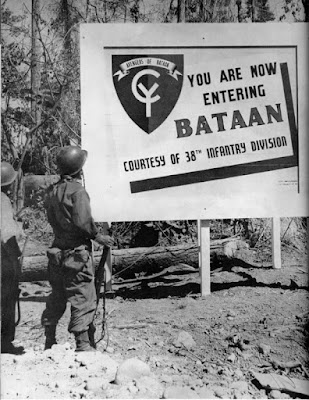 |
Welcome to Bataan
Public Domain.
Click to make bigger. |
Once we were on the road and passed a dead Jap officer, laying on his back as if he were asleep. His uniform was immaculate so he must have been high in rank. A couple of my guys fired shots at him. I made them stop. As much as I hated them I couldn’t help but wonder of the shock his family would have if they could have seen him.
We moved up the coast near Balanga, the capital of Bataan. At Pilar, I met some natives that had their homes in Balanga. They said they had to move as they were near the city jail and couldn’t stand the screams of the people being tortured all night by the Japs. This may sound morbid to some, but to us it was real, you or them.
Only one more story. I had heard this before about Japs throwing babies up in the air and stabbing them with a bayonet. Hard to believe, but I talked to people that seen two Japs walking and as a woman carrying a baby approached, one grabbed the baby out of her arms, threw it in the air, and stabbed it with their bayonet and laughed. They were so shocked that I couldn’t help believe them. One time a customer came in my barbershop. He was a little old. Said he had a store kind of like Kmart in Manilla. He was Chinese but came to the Philippines when he was 12 years old. He had raised ten children, put them all through college, had two children in Toledo that were professionals. I liked him real well and he seemed to like me also. We were pretty frank with each other. I commented once that I truly believed that Asians were naturally cruel. He laughed and said not so. Then he replied, “we went to Europe once, visited Spain, Italy, Switzerland, then visited Buchenwald and Auschwitz concentration camps.” He had me there, so I said I don’t know about that. Then we changed the subject as he made his point.
There is one more story I really don’t want to tell but I think I should. Each night we were in our foxholes we would wonder (at least I did) if we would make it through the night as the Japs would move into our area. Well, I’ve heard of guys praying, but I just couldn’t do it, much as I wanted to. I felt it was hypocritical. I felt bad at this as I wasn’t a Christian, although I believed in god. Anyways, on patrol, we got surrounded by machine guns. We didn’t think we would make it. Our radioman was busting up his radio so the Japs wouldn’t get it. The chaplain said he was tuned in to heaven. We would laugh a bit. No one looked scared, but I feel sure we all were. Pygmies lived in those mountains and we had two for guides. They knew a way down the cliff and we all made it except for one young Filipino who was killed by the Japs. I’ll never forget the wailing of his wife when she was told he was still up there. It was very dangerous going down that cliff as the way down was only about 3’ wide twisting and turning. The cliff was maybe 75 to 100’ down. I went along for the ride so to speak, but if I was in charge I would have went down the slope as I didn’t think the Japs had gotten that far and we could have brought the Filipino home. One of our guys went crawling up to the two Japs we had shot and cut off their ears looking for souvenirs. After that, I wondered what the Japs did to the Filipinos. I had been out looking for Japs that had made it swimming over from Corregidor when I bumped into this nut. I was told later that he was on patrol when they came across several Japs in a field. They tried to get away and he ran after them disregarding his sergeant’s order to come back. Then Japs hidden on each side of the open field shot and killed him. I wonder what became of his souvenirs.
After that, I got to thinking. The chaplain had a short service which I attended and I felt after that, I deserved to the right to pray and I told God if he would bring me home I would never deny him and would always pray. Well, I’m home and feel he had something to do with it, and I still pray.
One thing about the Filipinos, they were a happy people, despite the misery the Japanese did to them. I became friendly with a young lady with two children, a girl, 11, and a boy, eight. Her husband had been killed by the Japs. The kids and I would go to a nearby water hole, shoo out the water buffalo and go swimming. If it got dark I’d go back to camp, a little risky. There seemed to be two kinds of guerrillas. One group dedicated to kill Japs, the other seemed to avoid them. When the Japs were in the villages, they were in the mountains. When the Japs were driven out by us, they came to the villages and exploited the people. If it was dark, I’d walk down the street with the safety on my Tommy gun. I figured if they shot at me I’d get several of them before I’d hit the ground. Fortunately, that didn’t happen as I might have killed some civilians, too.
 |
Avengers of Bataan banner
Click to make bigger |
One other thing that was funny. We moved into an area where there was an ammo dump about 10 feet high and 20 feet square. I assigned the squads where they should be. The next day I heard talk of a woman screaming. I finally found out. A Sergeant Tonkin, 6’2” 220 pounds, thought he should move the squad to a safer place against my order. The Japs moved at night, so if we saw something move we would shoot. The sergeant (dummy) thought if he went quickly man to man he could tell them to move without being shot. Carbino was a guy that was sort of a gentle man and was laying on his back, thinking of home. Of course, the Japs could crawl in his foxhole (slit trench). Tonkin jumped Carbino, the kind of sissy guy figured it was a Jap. He grabbed his rifle and took hold of the barrel and slammed the stock into Tonkin’s head. Tonkin went down on his knees, Carbino pulled out his trench-knife and was coming down with it when Tonkin screamed. He went back to his slit trench and stayed there. I was going to chew him out but I thought he had enough trouble.
It might be of interest, guerillas (the good ones) had their leader in a tent next to our headquarters. We had a Jap that wouldn’t talk. The chief next door asked if they could have him, we agreed. A couple of our guys witnessed this. Two guys held bamboo clubs about three feet long and three inches thick. They went to work on the guy and he was very happy to talk, in fact, he told them everything.
Other Related Posts (links):